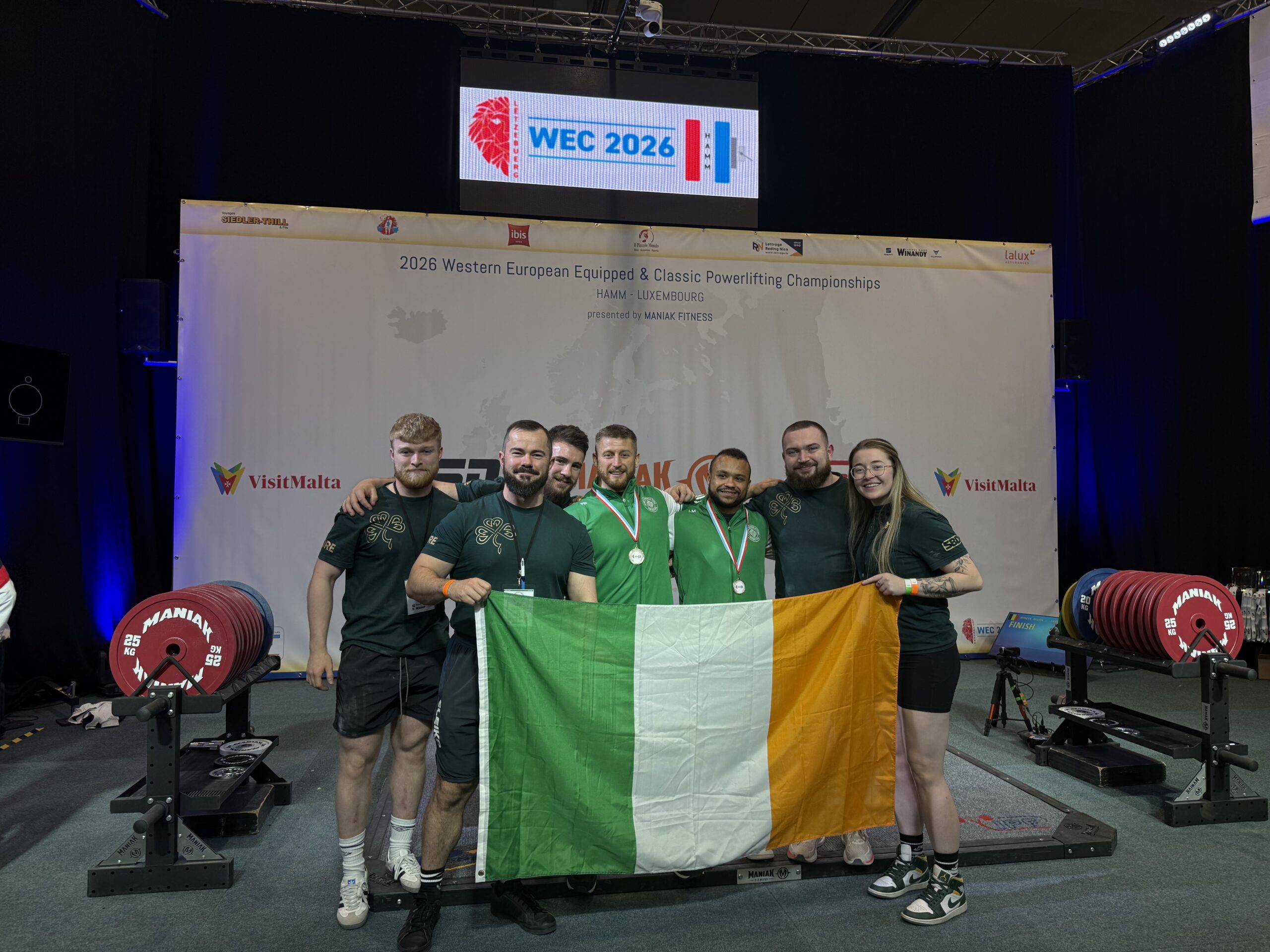
Clarice Tighe is a powerlifter, an accountant and a coach who has represented Ireland in a coaching capacity 15 times at World and European Championships. Diagnosed with Multiple Sclerosis at 21, she turned a shift in perspective into a coaching career that now spans her own business, a senior national team role and the treasurer’s seat at the Irish Powerlifting Federation. She is a student on the MSc in Applied Sport and Exercise Psychology with Setanta College.
Below, Clarice discusses the diagnosis that drew her into coaching, balancing two careers with international duties, and what studying with Setanta has added to her work with athletes.
A Diagnosis That Changed the Path
Clarice’s coaching journey began at a turning point in her own athletic career.
“I’m a powerlifter, an accountant, a dog mom and a coach. My coaching journey began after I was diagnosed with Multiple Sclerosis at 21. At the time I was a competitive athlete with goals of representing my country, but the diagnosis shifted my perspective on a lot of things, including what success in sport really looked like, and it drew me into coaching.
Since then I’ve been fascinated by the psychology of lifting and what happens in an athlete’s mind under the bar. I’ve always cared deeply about athlete mental health, and I’ve pursued a range of courses to build my knowledge in those areas. One way or another, each step has brought me to where I am today: a powerlifter, a coach, a senior national team coach, and now a student of Setanta College.”
Two Careers, One Full Week
Clarice balances a finance career with coaching, studying and international travel.
“I currently balance two careers: by day I’m an accountant and by evening I’m a coach. A typical weekday starts in my finance role, and once that finishes my coaching day begins. Evenings are spent working with athletes, reviewing training videos, writing programmes and checking in with them, alongside the admin of running my business.
Somewhere in between I fit my master’s studies, my own training, and my role as treasurer for the Irish Powerlifting Federation. Weekends are often spent at domestic competitions. A few times a year I travel with the Irish national team to various World and European Championships, which usually means a week away from home each time, while still keeping up my day jobs and studies. It’s definitely a balancing act, but I love what I do and I’m blessed with a great support network.”
Representing Ireland
Clarice’s coaching career has already taken her onto the international stage many times over.
“I started powerlifting coaching seven years ago and became a national team coach in 2022. Since then I’ve had the privilege of representing Ireland in a coaching capacity 15 times at various World and European Championships, most recently as Head Coach for the Western European Championships in Luxembourg.
One moment I’m especially proud of was being part of Ireland’s first ever all-female powerlifting coaching team back in 2024, a milestone I hope encourages more women into coaching roles in sport. Another standout highlight was coaching an athlete to a podium finish at the recent World Games in Chengdu, China. Alongside the international work, I run my own coaching business and have served as Treasurer of the Irish Powerlifting Federation for the last five years, helping to grow the sport behind the scenes. Any time I get to meet new athletes at a competition is always special.”
Why Setanta
Clarice wanted to understand the science behind something she had long sensed as a coach.
“I’ve always been fascinated by the psychology of lifting, and as a coach I naturally gravitated towards being very in tune with athletes’ emotions on competition day. Noticing first-hand how an athlete’s brain and nervous system respond under pressure made me incredibly curious to learn more.
Having already built a strong foundation in sports psychology, I was keen to understand the science underpinning it more deeply, and the master’s Setanta offers was the perfect fit. Being able to work full-time, while staying committed to my coaching duties and travelling internationally, all while studying a master’s degree, is difficult, but the Setanta flexibility and format make it possible for me. I’m hoping it will give me more evidence-based tools to help athletes perform consistently at high levels, and strengthen my skills and credibility as I continue to grow as a coach.”
 The Coach’s Presence as a Tool
“What I’ve enjoyed most about studying with Setanta is how directly the content applies to my day-to-day coaching. I love learning something in a lecture or reading something in a piece of research and immediately writing it down to share with my athletes or peers. I also really value the flexibility. Working two jobs, acting as treasurer, being a tutor on the International Coaching course for the International Powerlifting Federation, and being a national team coach is a lot to juggle alongside my master’s, so having a flexible structure and supportive lecturers who understand the coaching commitments has been incredibly important.
The lesson that has helped me the most is realising just how much impact a coach has through their communication and body language. Athletes are constantly reading the behaviours and emotions of the people around them, especially under the pressure of competition. Understanding this has made me hyper-aware of how I conduct myself, from my tone of voice to my facial expression in the warm-up room. On competition day, my calm and confidence can become theirs, so I now treat my own presence as one of the most important coaching tools I have.”
Advice for Others
Clarice’s advice is aimed especially at women entering strength sports.
“When I started coaching there were very few female coaches in strength sports, and there still aren’t enough. I regularly attend competitions where I’m the only woman in the room.
First, take up the space. You belong in that warm-up room as much as anyone else. Second, never stop learning. Invest in your education, ask questions, and stay curious. Third, reach out to your peers. Find other women in the sport, support each other, and don’t be afraid to ask someone further along for advice. Most people are happy to help. Finally, say yes to opportunities, even the ones that feel slightly beyond you. Volunteer at competitions, get your coaching qualifications, and put your hand up.
Every woman who steps into these roles makes it easier for the next one. When I was part of Ireland’s first all-female powerlifting coaching team, I realised how powerful it is to see women lead incredibly successful teams, and to be the representation that young women need. We belong in these roles just as much as our male counterparts, so take up that space and be the example for another young woman to follow.”
Looking Ahead
“I hope to just continue doing good work. I want to keep supporting my athletes to perform at their best, and I want to keep being a positive representation of female coaches. If a woman sees me at a competition and realises there’s a place for her there too, that would be incredible.
I’d love to become more actively involved in mentoring and developing other powerlifting coaches. I’ve benefited so much from the help I’ve received along the way, and I want to pay that forward. Hopefully, once I graduate, I’ll be able to do even more within the field and expand my business to reach more people across various sports.”
Learn more about the MSc in Applied Sport & Exercise Psychology.
