
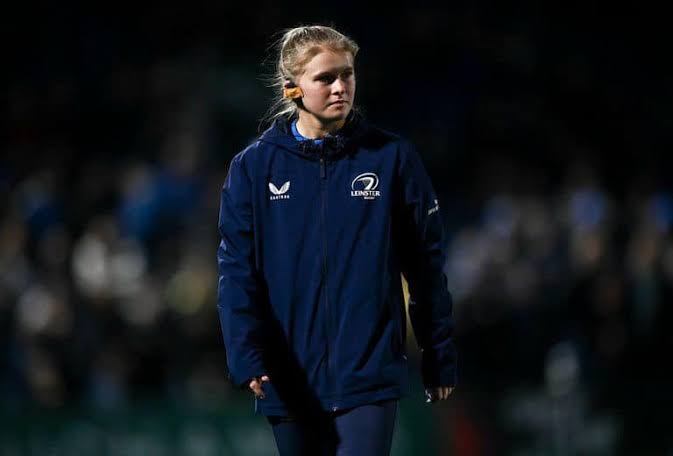
Leinster Rugby’s Orla Hayes on addressing movement competency before adding load, giving every player a clear focus, making sure they know why they’re doing the work, and the simple ways she reviews what’s working.
———————————————————————————————————————
“Each player will have a primary focus and a secondary focus,” she says. “I try and keep it to one or two goals, because if you try and tackle too many things at the one time, it can be easy to let things fall through the cracks.”
Orla Hayes is the Pre-Academy Athletic Development Coach in Leinster’s Centre of Excellence, working with the province’s U20s cohort. In a recent Setanta College webinar, Developing the U20s Athlete, she walked through how she plans and coaches a year with young players who are making the jump from school to adult sport.
Movement first
Movement quality is the first thing Orla addresses when players arrive.
“You don’t want to be six months into the year and still trying to correct someone’s squat pattern, having to pull back the weight and then having to rebuild back up,” she says. “If you can nail those movement patterns on all your key lifts and how they’re running out on the pitch, it sets you in a really good place for building on strength and power capacities after that.”
The test is whether it shows up in the game.
“It’s really good being super-fast and really, really strong in the gym, but if they can’t actually transfer those qualities into what they’re trying to do on the pitch, then it’s not really worth it.”
Connection with the players
Hayes describes her coaching philosophy through four words: energy, presence, impact and connection.
Giving players a say in their own development has been key.
“When players feel like they have autonomy in their sessions, they feel more valued, and they have better buy-in to programmes,” she says. “It’s not me saying to them, ‘You’re going to get better at this.’ It’s me having a conversation around, ‘Well, what do you think you need to get better at? What do I think you need to get better at? How do we align the two?'”
Trust before content
Hayes sets out how all of this is implemented as a pyramid, with trust at the base, followed by engagement, goal clarity and accountability, and the programme itself at the top.
Goal clarity, in particular, gives players a purpose behind their work. When she builds development plans with players, she brings it back to a few simple questions.
“I always come back to them understanding what they need to do for that one session, that one pitch session. What’s their focus when they’re doing speed outside? What’s their goal for the next five weeks? What’s their goal for the next 12 months?” she says. “I think when the players know what they’re working towards, it gives them a really good focus point for everything that they do.”
Without that, she has found, players can drift.
“If they don’t have that, it’s very easy for players, what I’ve found at this age group, to just go through the motions,” she says. “They’re doing their speed work outside. They don’t really know why they’re doing this.”
That means showing players how every part of the programme links back to the pitch.
“Do they know that, okay, we’re developing this in the gym because it’s going to make you better at this on the pitch?” she says. “Them having an understanding of everything that they do, whether it’s in the gym or it’s in their speed sessions or whether it’s nutrition workshops, how that makes them better rugby players, I think that’s been a really good buy-in point.”
Without those foundations, she says, the programme itself counts for little.
“You could have the best programme in the world, but if you don’t have engagement from your players, you don’t have trust from them, they don’t know what their goals are, it’s going to be really hard to achieve positive outcomes.”
Reviewing success
Hayes reviews success across several measures: testing results across four windows, injury audits, rugby performance and coach feedback, selection numbers, and player feedback.
“A massive one for me is actually player feedback,” she says. “Although it’s a development space, I’m very conscious that it’s also an area where I want the players to be able to come in and enjoy the sessions that they’re doing.”
She has also started using small trials before rolling out new ideas.
“Something that I’ve only started to do recently was the idea around doing safe-to-fail experiments with the players. Taking a small cohort of players and trialling it, and seeing if it works,” she says. “At the end of the day, you have to make mistakes to learn.”
For younger groups, keep it simple
When discussing planning two summer sessions a week for an U16 team, her advice was to start with the basics.
“It could be that you consistently get them to sprint once a week at training, whether you incorporate that into a game, a chasing game, or something like that,” she says. “It doesn’t take a massive amount of facilities or access to equipment.”
“Less is more at that age group. The simpler you can keep it, the better it is long term. You don’t need to be trying to teach them how to do 500 different things across the summer.”
Watch the full webinar
The full webinar ‘Developing the U20s Athlete’ is available at www.setantacollege.com/webinars.
