
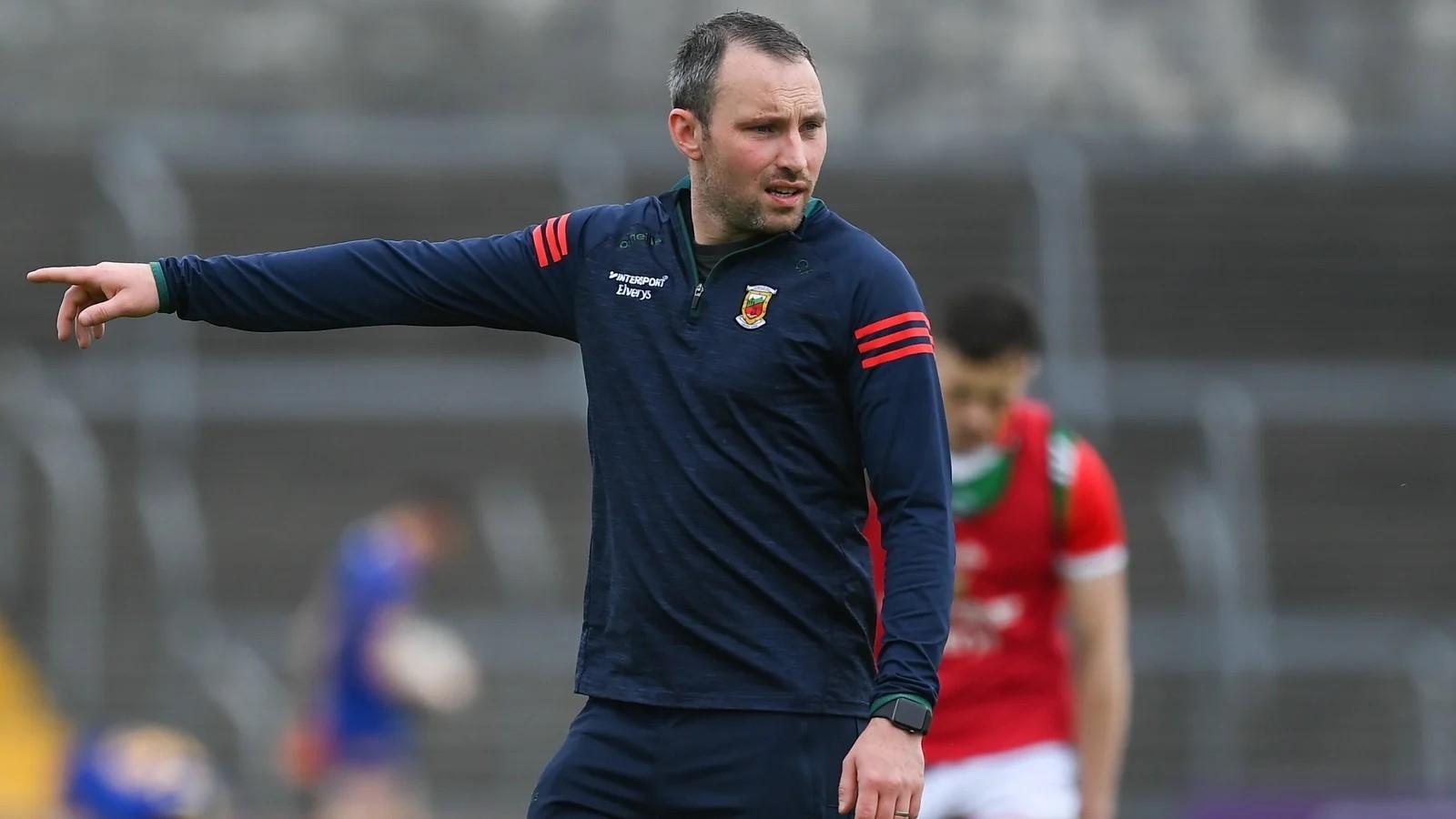
Conor Finn starts every season by thinking about the hardest game his players might face.
“If you’re in a championship that has the potential to go to extra time, if that comes at the players, it shouldn’t be the first time of the year that they’ve been exposed to it,” he says.
Head of Performance for Mayo’s All-Ireland winning footballers this year, for over 15 years he has worked across county, club, Sigerson, minor, hurling and football.
In a recent Setanta College webinar, Off-Season to Championship – S&C Planning and Periodisation in Gaelic Games, he outlined the framework he uses.
“Periodisation for me is building the capacity in players so that no matter what comes at them on game day, extra time, championship heat, they’re prepared for it,” he says. “And then managing that around the fatigue that comes with it, making sure that players are fresh, that they’re able to show that capacity on the days that most count.”
Starting with the Calendar
The fixture calendar is the starting point, as it is the one element outside the backroom team’s control.
“When you’re looking at the season ahead of you, you’re looking for pockets where you can load and where you can build capacity,” he says. “You’re looking at games that are going to be targets. You’re spotting straight away weeks that are going to be taper weeks, games that potentially you may train through, carry a bit of fatigue through.”
Pre-season offers the most flexibility.
“There’s that window where there’s no games for the most part. It could be improving body composition, putting on some lean weight, working on strength, and working on power. I think everyone that works in this profession loves that part of the season.”
Once the league starts, he says, the fixtures largely manage the deloading.
“You’ve got your taper weeks. You have target games that you really are tapering into more than others, and that gives that physical deload.”
The Schedule
Control of the training schedule is central to everything else.
“If you don’t have control of the schedule, how can you get your big sessions in there? How can you make sure players are going to be fresh when you need to have intensity?”
The principle that Mayo work to is 72 hours between a game, or a heavy session, and the next meaningful pitch session.
“We’ve found, and we’ve tried different ways, that this just works for us,” he says. “It mitigates risk significantly. It means you get good intensity. If it’s one week, you’ve got one session on a Wednesday, you don’t want that session being flat.”
He acknowledges that fixed club training nights can make this difficult.
“I’ve worked in scenarios where that’s the case, and there’s logistical reasons and everything else, and it’s all valid. But you cannot deliver an optimal periodised programme, or optimal sessions every week, if it’s like that.”
There are exceptions. On a six-day turnaround, the coaching staff still need time with the group.
“The coaches have analysis that they’re doing on the game that needs to be fed back to players,” Finn says. “So, getting them together on a Tuesday where you’re doing walkthroughs, some skills, low-level stuff, but they’re getting moving. Nice sharp session on the Thursday, and you play on Saturday. That can work. Nothing is a rule.”
Gym work is planned around the pitch sessions rather than the other way round.
“We never end up in a situation where a pitch session needs to be reduced because they had a heavy gym. We’re looking at what the pitch session is and then programming in the gym around that.”
Looking Beyond Total Distance
Finn sees the reliance on total distance as one of the most misunderstood areas, particularly at club level.
“If we knew that this game was 10K, it gives us some information – almost nothing, but some information,” he says. “In terms of comparing it to training and using it to plan your training session, it’s almost worthless.”
He points instead to the breakdown. In a 10K game, a player might walk around 20%, jog around 25%, run around 40% across a range of speeds, and sprint for about 2%.
“The game is really intermittent. It’s rare that you get up to those speeds. It might be one, two, maybe three times a half. Depending on role, a player might not get above 80% in an entire game.”
Mayo plan around a single metric, high metabolic load distance (HMLD), which combines high-speed running with high-intensity accelerations and decelerations.
“If your training session has football in it – medium-sized games, 11 v 11s, 7 v 7s – the ratios generally are going to be pretty close to what they would be in a game,” Finn says. “So you can use that one metric, and you know everything else is going to be about right.”
He adds that the metric is less reliable when sessions are built on running blocks.
“You can hit this metric, and you’ll see it on your GPS report, but it could be 90% just high-speed running at one set intensity. You can miss out a lot on the distance accelerated, the distance decelerated.”
“It’s Football”
Football is the primary conditioning tool, followed by targeted running and then the gym.
“Players and other coaches will always ask, ‘What run are you doing?’ It’s football. It’s different dimensions of a pitch, different numbers of players, different intensities, supplemented with conditioning.”
 “The twists and the turns, the reacting, accelerating, decelerating, the different range of speeds. No matter what running drills you’re doing, you can’t replicate it.”
To prepare for worst-case match day demands, Mayo overload specific metrics rather than everything.
“You’re not going to play 120 minutes of football in a training session. So, you selectively overload metrics. You’re picking the metrics that really matter, and you’re going after those rather than everything.”
With two weeks between games, density provides the main conditioning stimulus.
“You’re getting that fitness hit by non-stop work for 35 up to 40 minutes without a break. Ball goes over the sideline and it’s just thrown in again. That can give you a huge fitness hit without the overall volume.”
In season, gym work is often delivered in short blocks around training.
“They get their football, say 70 minutes. They come back in, 10 or 15 minutes in the gym, and they’re done,” he says. “It saves the guys an evening the following day, but it also benefits us because it’s mitigating the risk for the next session.”
Monitoring and Adapting
Mayo use GPS and an acute:chronic workload ratio mainly to plan ahead, but Finn is clear about its limits.
“It’s not ever as simple as an acute:chronic telling you when someone’s going to get injured or telling you that someone’s going to be fresh. It doesn’t unfortunately work like that. It informs, but it doesn’t dictate anything.”
With the coaching staff, the aim is to keep it simple.
“We’re giving one metric to the coaches, and then we’re feeding back one metric,” he says.
When a drill runs over, the football takes priority.
“You can’t be stepping in and stopping that. That is the most important thing of that session. But you need to then adjust it after.”
His final principle is to expect the plan to change.
“You might make a league final, and that’s going to change what you had planned. So expecting it to change, being clear on your outcome that you want to achieve, and just flexible about how you’re going to get there.”
Watch the Full Webinar
The full webinar ‘Off-Season to Championship – S&C Planning and Periodisation in Gaelic Games’ is available here or at www.setantacollege.com/webinars.
