
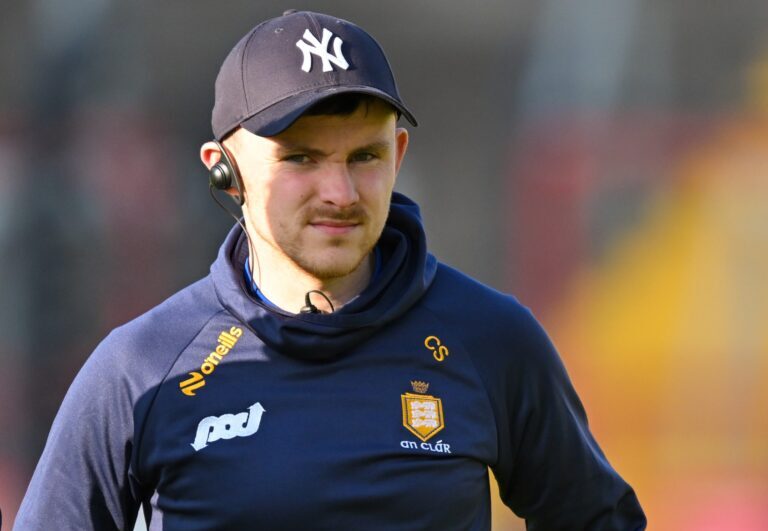
Clare GAA’s Athletic Performance and Talent Development Lead on the movement gap in Irish children, why a six-week S&C block isn’t enough, and simple ways to build athletic development into every club session.
Over the past decade, Conor Shannon has noticed a trend in the young players arriving into Clare’s academy squads.
“This is probably my 10th or 11th year taking in kids who are under 14 into academy squads, and on the face of it, they’re the most talented kids,” he says. “And I’ve seen a drop-off in movement skill year on year with each cohort we take in.”
Shannon is Athletic Performance and Talent Development Lead with Clare GAA, working with squads from under-14 to under-20. In a recent Setanta College webinar, Little & Often: Making LTAD Work in the Club Environment, he set out how clubs can build athletic development into what they already do.
“It’s not going to be a case of here’s a million exercises that you can start doing that are going to turn your kids into supreme athletes,” he says. “It’s more so how can you fit and embed athletic development in the club environment, considering the different constraints you’re working under.”
The Movement Gap
Shannon points to a 2019 study by Stephen Behan on fundamental movement skill (FMS) proficiency in Irish primary school children, which found that only one in five could perform all of the fundamental movement skills proficiently. Girls also typically lagged behind boys in locomotor and object control skills.
“It was poor at the time, and it’s potentially poorer again now that we’re further down the track,” he says.
The window to address it is early. FMS mastery typically peaks between 10 and 12, and Shannon says competence at that age is closely linked to whether children stay active.
“It is quite tough to predict what players are going to be successful in their sport. But we can definitely predict if kids are going to be active or not based on if they’re competent at FMS by third or fourth class in school.”
With children getting less free play than previous generations, he believes clubs have a bigger role to play.
“Clubs and schools and coaches, we probably have an onus to make up for that shortfall of organic free play, where kids are playing themselves and mastering movement themselves.”
Why ‘Little and Often’
Shannon recognises the constraints clubs work under: volunteer coaches juggling full-time jobs, one or two sessions a week of 60 to 90 minutes, shared pitches, and wide differences in maturity and ability within the same squad.
It is why he is wary of the six-to-eight-week S&C block brought in over the winter.
“That’s them ticking off the box of S&C or athletic development for the year, and it’s not touched again,” he says. “Typically, the work that’s done, or the expertise that’s been shared, leaves with the coach. So, I’d much prefer if things were simple and little and often, and there throughout the 12 months of the year.”
Coach the child in front of you
Shannon draws on principles from the NSCA’s position statement on long-term athletic development, starting with the idea that every child is an athlete.
“Irrespective of how talented they are at the sport, can we make sure that they’re a really talented and proficient mover? Because down the line, we can make them better at the sport.”
He encourages a broad movement base, including other sports, over early specialisation, and says strength training is no longer something to worry about.
“Strength training, it’s safe, it’s effective, it keeps kids engaged in sport, it keeps kids on the field, but also it helps with skill acquisition as well.”
The final principle is individualisation.
“Coach the child in front of you, not their birth certificate. If I’m coaching an under-13 group, I might have kids who look 11 and kids who look 15, and they’ll need different strategies and different tasks and different challenges.”
That matters most around the growth spurt, when players can appear clumsier for a period.
“As coaches, realise these players aren’t finished or have lost their talent,” he says. “They’re getting use of a new body, so they’re having to relearn all their FMS skills of how to run, jump, catch, kick a ball, and that takes a little bit of time.”
Three ways to fit it in
The question Shannon hears most is how to find the time.
He suggests three models. The first is the warm-up.
“That’s your real opportunity to get athletic development in throughout the year. If you’re clever and creative with your warm-ups, you can include any sort of athletic development task in that 10 minutes.”
Games such as sharks and minnows, stuck in the mud, traffic lights, tag and animal relays develop acceleration, balance, reaction and agility. Static stretching and adult-style warm-ups, he says, are of no benefit to young players.
The second is the “athletic snack”, a two-minute speed or strength hit in the transition between drills.
The third, where clubs have enough coaches, is a station rotation: a technical station, a game station and an athletic development station of 10 minutes each, finishing with a match.
“If you just implement that 10 months of the year, you’ll get a really good bang for buck there.”
Together, he says, these can add 25 to 30 minutes of athletic development to a session “without having to do anything extra or without having to try and upskill yourself.”
Disguise it as a Game
For strength, Shannon suggests movement patterns disguised as games.
“You don’t need an S&C coach with your under-10s. You don’t need a fully equipped gym. For your squat pattern, you could have them in a wall sit battle. For your hinge, you could have them doing crab soccer. For your push, you could have wheelbarrow races. For your pull, you could have tug of war with bibs or with hurleys.”
Simple external cues work best: land quietly, as if on eggshells, or push the ground away when sprinting.
“If you tell a child to walk like a duck, there you go, they’re in a squat pattern,” he says. “They’ll assume that position themselves from that external cue.”
Measuring Success Differently
Asked how clubs balance long-term development with the pressure for results, Shannon points to clubs in Clare taking a different approach.
“We’ve got clubs in Clare now who have a philosophy of not really caring about what they win at underage, and we’re starting to see it at adult level. They’re starting to win at adult level, which ultimately is where you want to win.”
“Success can be viewed in a multitude of ways. It’s not dictated by what the scoreboard says in an under-14 game. It’s more if I started off the year with 30 under-14s, do I finish the year with 30 going to under-15?”
Watch the full webinar
The full webinar ‘Little & Often: Making LTAD Work in the Club Environment’ is available at www.setantacollege.com/webinars.
